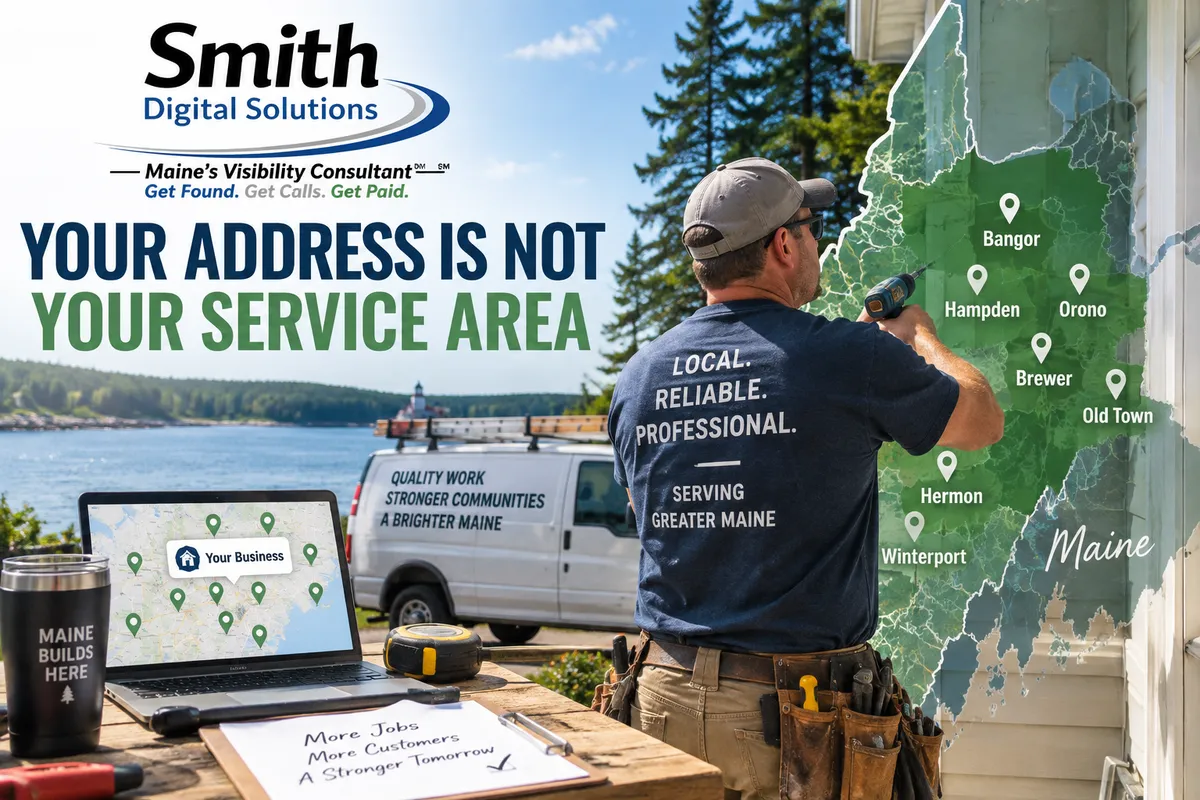
Service-Area Businesses: Your Address Is Not Your Service Area
A contractor can be based in Bangor and serve Hampden, Brewer, Hermon, Old Town and Orono. A dog groomer may have one physical location. A property-service company may never serve a customer at its office at all.
Those are different business models, and the way your business information is presented should make the difference clear. Your business address tells people where the business is located. Your service area tells them where you actually work. They are not the same thing.
For local visibility, that distinction matters to customers, Google and the growing number of AI systems that use public business information to decide what a company is, where it operates and whether it is relevant to a local question.
Start With the Business Model
Google distinguishes between storefront businesses and service-area businesses. A service-area business travels to customers rather than serving them at the business address. If customers do not come to that address, Google says the address should be hidden from the public Business Profile.
That does not make the business less local. It simply describes the business accurately.
A Service Area Is Not a Ranking Trick
Adding a long list of towns does not create a promise of better rankings. The purpose is accuracy: customers should be able to tell whether you actually serve their community, and your website, Business Profile and other trusted sources should tell the same story.
If a business truly serves Bangor, Brewer and Hampden, those communities should appear naturally and consistently in the places where customers look for that information.
Your Website Has to Back Up the Profile
A Business Profile should not be the only place that explains geography. Your website should make the service area understandable, too.
That can mean a clear service-area section, useful local service pages where warranted, accurate contact information and language that distinguishes your physical location from the communities you serve. The goal is not to manufacture dozens of thin town pages. It is to give people and machines enough factual context to understand the business.
Consistency Is the Visibility Advantage
The strongest local entities repeat the same true facts across their website, Google Business Profile, Bing, trusted directories, local media and other credible sources.
When one source says Bangor, another says statewide Maine and an old directory still shows a former address, the business becomes harder to understand. When the name, phone, business model, service area and services agree, the entity becomes clearer.
One Simple Check
Look at your business as if you had never heard of it before. Can a customer answer three questions in a few seconds: Where are you based? Do customers visit you there? Which communities do you genuinely serve?
If those answers are difficult to find, the next visibility project may not be another ad or another social post. It may simply be cleaning up the facts.
Quick Answers / Q&A
What is a service-area business?
A service-area business travels to customers or delivers services to them rather than serving customers at a public business address.
Should a service-area business show its home address on Google?
If customers are not served at the address, Google instructs service-area businesses to remove or hide the address from the public Business Profile.
How many service areas can a Google Business Profile list?
Google currently allows service-area businesses to specify up to 20 service areas. The areas should reflect where the business genuinely operates.
Does adding more service areas improve Google rankings?
Google does not say that adding more service areas boosts rankings. Service areas should be used to describe the real operating geography accurately.
Should service areas also appear on the website?
Yes. A website should make the communities a business actually serves clear and consistent, without creating misleading locations or pretending the business has storefronts where it does not.
Why does this matter for AI visibility?
AI systems work better when they can find consistent, corroborated facts about a business. Clear geography reduces ambiguity about where a business operates and which local questions it may be relevant to.
