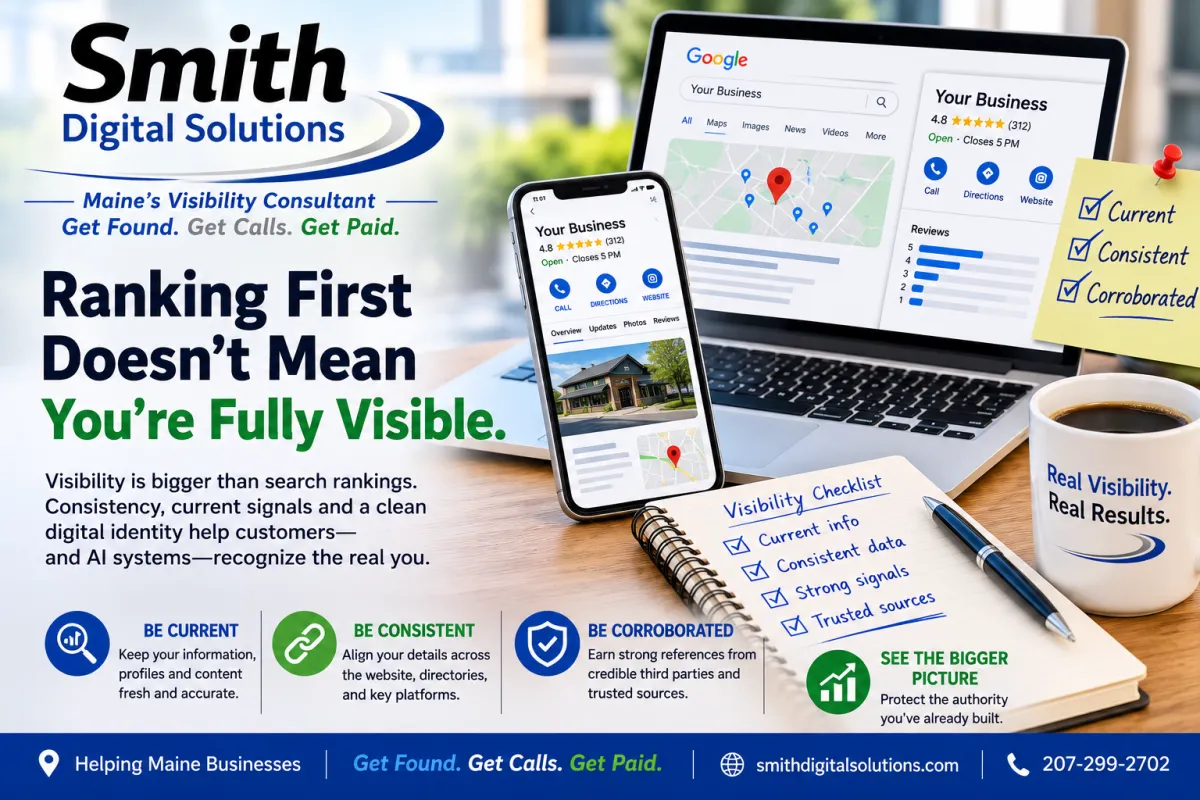
Your Business Can Rank Well and Still Have a Visibility Problem
A business can rank first on Google and still have a visibility problem.
That sounds contradictory until you stop treating visibility as a single ranking. Search results are only one layer of what customers - and increasingly AI systems - see when they try to understand a business.
A strong position in Maps or organic search can hide stale profiles, outdated business information, weak location pages, old brand references and conflicting third-party listings. The business may be easy to find today while the digital identity underneath it is slowly drifting out of alignment.
Ranking Answers One Question
A ranking tells you where a business appeared for a particular search, in a particular place, at a particular moment. That matters. It can produce calls, clicks and visits.
But it does not tell you whether the business information is current. It does not tell you whether Google Business Profile photos are fresh, whether posts are active, whether the website accurately describes each location, or whether outside directories are still carrying an old name, old hours or a closed location.
Visibility Depends on Current Signals
Google Business Profiles are living assets. A business that has not added new photos, products, offers or posts in months may still rank because it has years of reviews and authority. But it is leaving current signals unused.
For customers, freshness matters because they want to know what the business looks like now. For search engines and AI systems, current content provides more evidence about what the business offers today.
The right language is not that Google automatically penalizes every quiet profile. It is that a stale profile gives up opportunities to reinforce relevance, activity and engagement.
Entity Drift Is the Other Half of the Problem
Entity drift happens when the web contains multiple versions of the same business. One directory has old hours. Another has a former location. A legacy website page uses an old brand name. A chamber listing has a phone number that changed three years ago.
People can often recognize that those records refer to the same company. Machines have to reconcile them. The cleaner and more consistent the data is across the website, Google Business Profile, directories, review sites and authoritative third-party sources, the easier it is for search and AI systems to understand the business with confidence.
Ask Three Questions Instead of One
Instead of asking only, "Where do we rank?" ask three questions:
Are we current? Does our public presence reflect the business as it operates today?
Are we consistent? Do our name, address, phone, hours, locations, categories and brand language agree across important sources?
Are we corroborated? Do credible third-party sites, media, associations, directories and backlinks reinforce the same identity?
Those three questions expose problems that a ranking report can miss.
Protect the Authority You Already Earned
The most interesting visibility problems often appear inside established businesses, not new ones. They already have reviews, backlinks, rankings and name recognition. The issue is that years of growth create layers: old websites, old locations, old categories and old profiles.
That is good news because the authority does not need to be invented. It needs to be cleaned up, connected and kept current.
Smith Digital Solutions helps Maine businesses audit that larger visibility system - Google Business Profile, website, local search, entity consistency and AI visibility - so the business customers find online is the same business operating today.
