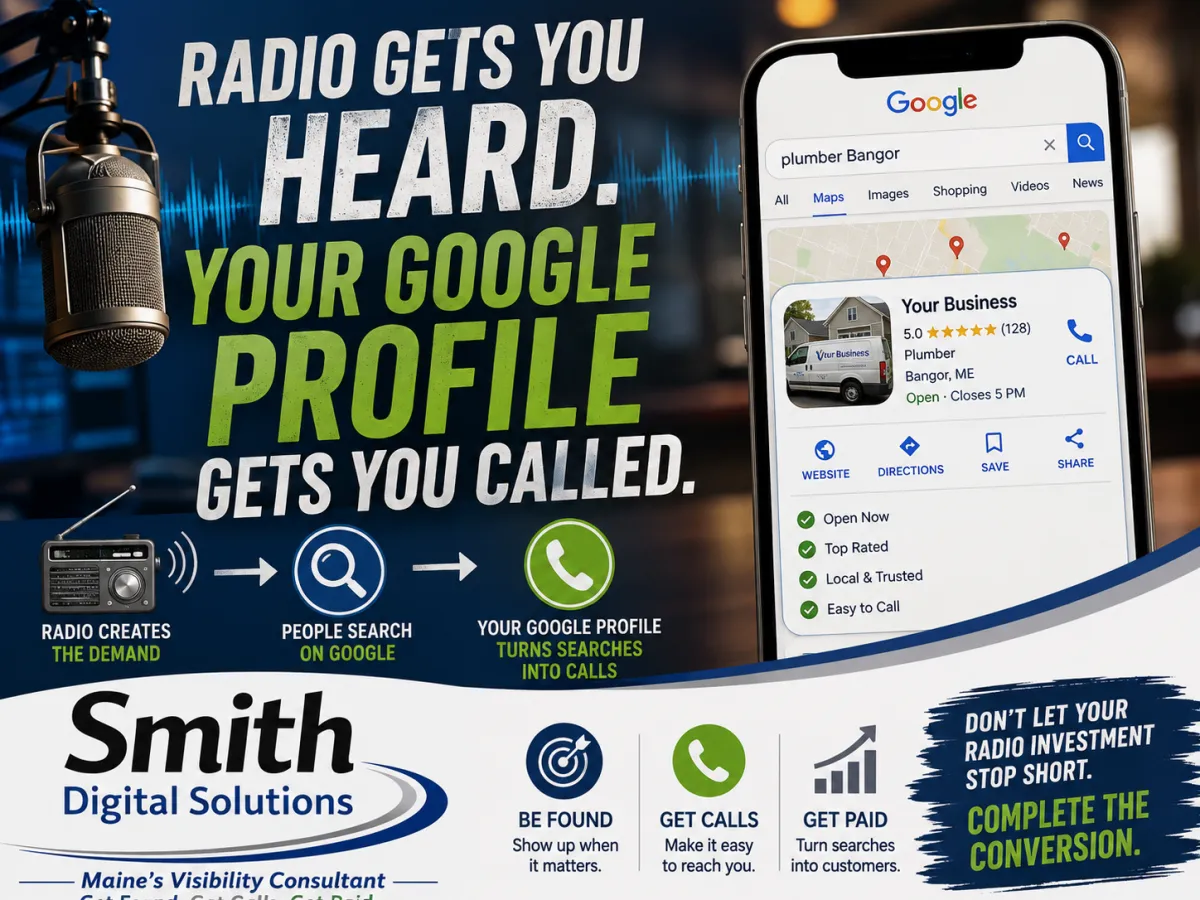
Radio Gets You Heard. Your Google Profile Gets You Called.
Radio advertising works. Let's get that on the table right away, because this isn't an article telling you to cancel your radio spend. Radio builds name recognition, keeps your business top of mind, and reaches people in their cars and kitchens all across the Bangor region. Businesses that advertise on local radio are making a real investment in being known.
But here's what happens after your spot airs — and it's the part most businesses never think about.
What Listeners Actually Do When They Hear Your Ad
Almost nobody hears a radio ad and dials a phone number from memory. What they actually do, hours or days later, is pull out their phone and search. They type your business name — or worse, just your category — into Google. And whatever Google shows them in that moment decides whether your radio investment turns into a phone call or evaporates.
If your Google Business Profile is complete, accurate, well-reviewed, and showing up in the map pack, the radio ad finishes its job. The listener finds you, sees a business that looks as good as it sounded, and taps the call button.
If your profile is thin, outdated, missing photos, or — the worst case — a competitor outranks you for your own category, then your radio dollars just did the hard work of creating a customer and handed them to someone else.
Radio Creates the Demand. Google Captures It.
Think of it as a relay race. Radio runs the first leg brilliantly: awareness, familiarity, trust in your name. But radio can't run the second leg. It can't answer "are they open right now," can't show your reviews, can't display photos of your work, and can't put a call button under a listener's thumb. That handoff happens on Google — and a dropped handoff loses the race no matter how fast the first leg was.
This is why the question isn't "radio or digital." The businesses getting the best results in our area are the ones treating them as one system: radio generates the search, and an optimized Google Business Profile converts the search into a call.
The Three-Minute Test
Want to know if your radio spend is converting? Search your own business name on your phone, the way a listener would. Then search your category — "plumber Bangor," "dog boarding Glenburn," whatever you are. Ask yourself three questions. Do you appear immediately, with correct hours and phone number? Does your profile look like the business your ad described? And on the category search, are you in the map pack at all?
If any answer is no, there's a gap between the awareness you're paying for and the calls you're getting — and that gap is fixable.
Make the Spend You're Already Making Work Harder
The most efficient marketing dollar isn't always a new dollar. Often it's making a dollar you already spend convert better. A radio campaign paired with a fully optimized Google Business Profile doesn't cost much more than the radio campaign alone — it just stops leaking.
If you're advertising on local radio and you're not sure what listeners find when they search you, that's exactly the kind of question a visibility baseline answers. Get found. Get calls. Get paid — in that order, because that's the order it actually happens.
