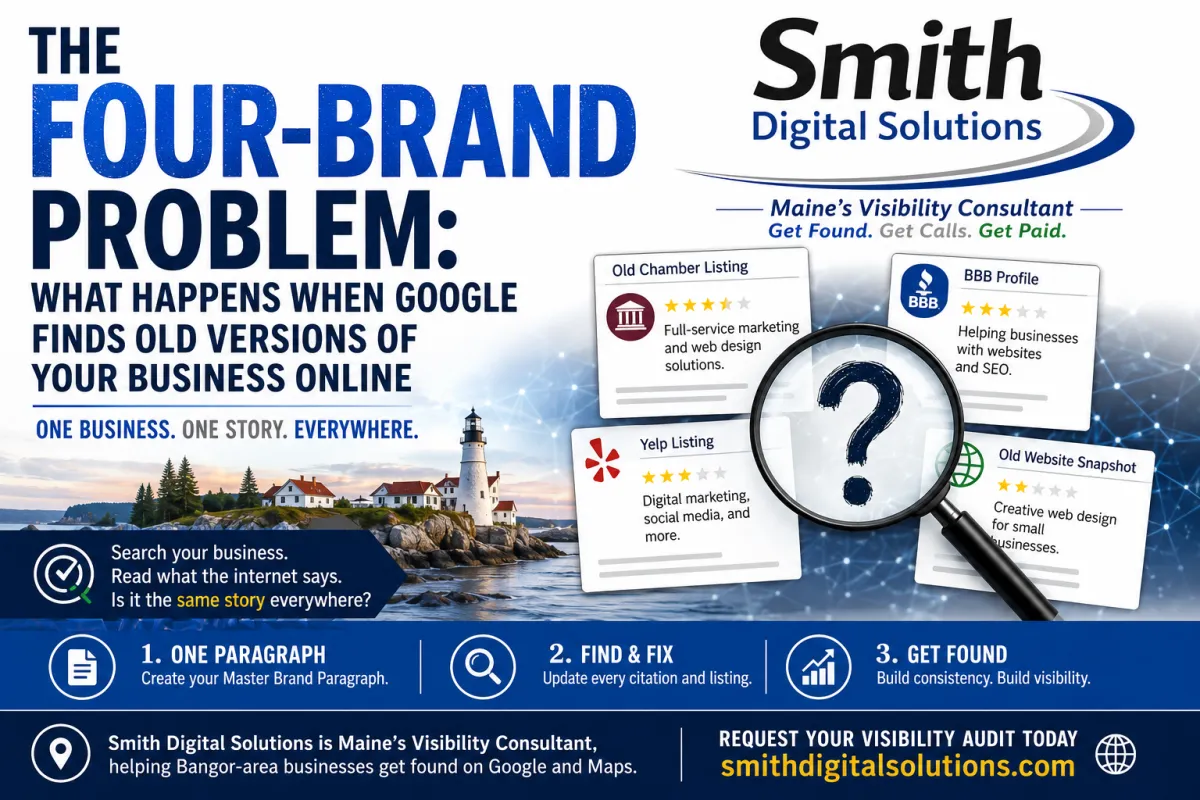
The Four-Brand Problem: What Happens When Google Finds Old Versions of Your Business Online
This month I ran a visibility audit on a Bangor-area business I know well and found something remarkable: four different versions of the same company, all alive on the internet at once. Four different descriptions. Different taglines. Different emphases. A search engine trying to figure out what this business actually does had four conflicting answers to choose from. And here's the uncomfortable part: this business has a good website, an active Google Business Profile, and an owner who pays attention. It still happened.
How a Business Ends Up With Four Brands
Nobody sets out to have four brands. It happens the way most visibility problems happen: gradually, and for good reasons. A business evolves. You sharpen your positioning, drop a service, add a specialty, rewrite your tagline. Each change goes on the website and the Google Business Profile — the places you look at every day.
But your business is described in dozens of places you don't look at every day. Old chamber listings. A BBB profile written years ago. Yelp. Alignable. Facebook's About section. A listing site that scraped your website in 2023. Each one preserved whatever version of your business existed the day it was written — and every one of them is still out there, telling its own version of your story.
Why Search Engines Punish the Confusion
Google builds its understanding of a local business by cross-referencing every mention of it across the web — the same way a careful reference-checker would. When those mentions agree, Google's confidence rises, and confident results rank. When they conflict, confidence drops. The business doesn't get a warning letter; it just quietly shows up less, ranks lower in the map results, and loses calls to competitors whose story is consistent everywhere.
The newer AI answer engines are even less forgiving. When someone asks an AI assistant to recommend a business like yours, it synthesizes an answer from everything it can find. Four conflicting descriptions don't average out into a clear recommendation — they average out into being left out of the answer. The test: search your business name right now and read the first ten results as a stranger. Do they all describe the same company, the same way? If not, you have your own version of the four-brand problem.
The Fix: One Paragraph, Everywhere
The cure is a Master Brand Paragraph — one definitive description of your business, written once, deployed verbatim everywhere your business is mentioned: your website, your Google Business Profile, every citation, every listing site, every social profile. Not four stories. One.
Then the sweep: a systematic pass through every platform where an old version of your business survives, replacing each with the master paragraph. It's not glamorous work. It's also some of the highest-return visibility work a local business can do, because it fixes the foundation everything else stands on. In the audit I mentioned, Google accepted the updated business profile within days of the master paragraph going in — and from there, a consistent story starts propagating outward, one platform at a time.
The Lesson From That Audit
The business in that audit wasn't neglected — it was growing. That's the real lesson: brand drift isn't a mistake, it's a byproduct of growth. The businesses that stay visible aren't the ones that never evolve; they're the ones that clean up after their own evolution. If it's been more than a year since anyone checked what the internet says about your business, the internet is probably telling more than one story.
Frequently Asked Questions About Business Citations and Brand Consistency
What is a business citation?
Any online mention of your business's name, address, phone number, and description — listing sites, chamber listings, review sites, social profiles. Search engines cross-reference citations to verify what your business is and where it operates.
Do inconsistent citations really hurt local rankings?
Yes. Conflicting business information lowers a search engine's confidence in your listing, which typically means reduced visibility in map results and local search — and weaker representation in AI-generated answers.
What is a Master Brand Paragraph?
A single, definitive description of your business deployed word-for-word across your website, Google Business Profile, and every citation and social profile, so every source tells the same story.
How often should a business audit its online presence?
At minimum once a year — and immediately after any rebrand, service change, move, or phone number change. Every business change creates new opportunities for old information to linger.
How many versions of your business is Google finding?
Smith Digital Solutions is Maine's Visibility Consultant, helping Bangor-area businesses get found on Google and Maps. Get found. Get calls. Get paid. Request a visibility audit at smithdigitalsolutions.com.
