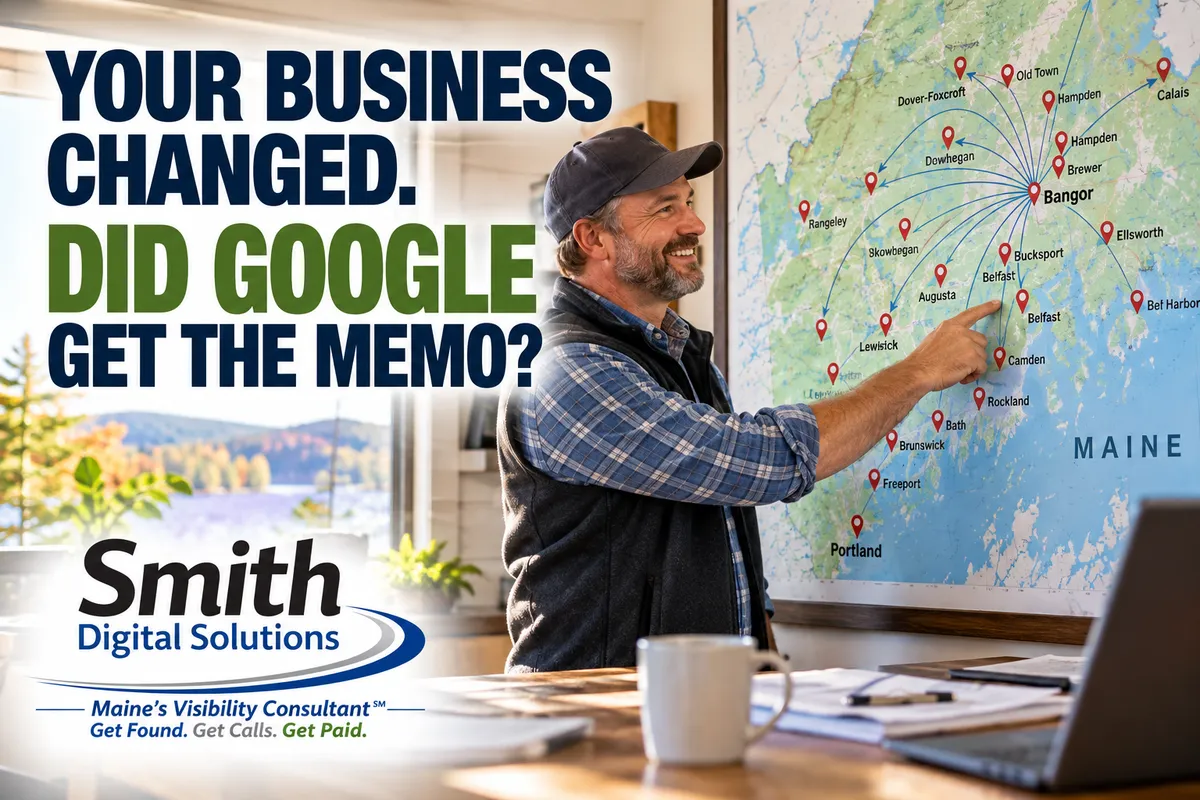
Your Business Changed. Did Google Get the Memo?
Businesses change.
They add services.
They stop offering services.
They move.
They expand into new towns.
They change phone numbers.
They hire people.
They open another location.
They go from serving one community to serving an entire region — or, sometimes, an entire state.
The problem is that the internet does not automatically keep up.
You may know exactly what your business is today. Your customers may know. But Google, Maps, directories and AI systems may still be looking at pieces of the business you were three, five or ten years ago.
That can create a visibility problem even when everything else in the business is going well.
Your Old Business Doesn’t Disappear From the Internet
Suppose you started out serving Bangor.
A few years later, you added Brewer and Hampden.
Then Waterville.
Then Augusta.
Eventually your crews were working across a much larger part of Maine.
Your business evolved.
But what happened to all the places where your old business information was published?
Maybe your Google Business Profile still emphasizes Bangor.
One directory still describes you as serving Greater Bangor.
An old website page lists only Penobscot County.
A business association profile uses a description you wrote five years ago.
Another listing has an old phone number.
Your Facebook page describes services you no longer emphasize.
Meanwhile your current website says something different.
None of those individual problems may look catastrophic.
Together, they create uncertainty.
Google Is Trying to Figure Out Which Version Is Correct
Search engines spend an enormous amount of effort trying to understand businesses as entities.
That means answering basic questions:
·Who is this business?
·What does it do?
·Where does it operate?
·How can customers contact it?
·Which website belongs to it?
·Which services should it be associated with?
·Is the information trustworthy?
The clearer and more consistent those answers are across the web, the easier it is for a search system to understand the business.
When the answers conflict, the picture becomes less clear.
That is why visibility isn’t simply about adding more content.
Sometimes the first job is cleaning up what already exists.
AI Has Made Consistency Even More Important
This gets more interesting now that people are asking AI systems questions that used to go directly into a Google search box.
Someone might ask:
·Who paints houses in Augusta?
·Who can prepare my property for sale in Waterville?
·What’s a good dog boarding facility near Bangor?
·Who helps Maine businesses with Google visibility?
An AI system needs enough reliable information to understand which businesses are relevant to the question.
It may encounter your website. Your Google Business Profile. Business directories. News articles. Reviews. Association pages. Social profiles. Other websites that mention your company.
Those sources help form a picture.
If they all describe essentially the same business, that picture becomes easier to understand.
If they describe several different versions of your company, you have made the job harder.
Your Business Name Is Only the Beginning
People often hear the phrase NAP consistency: Name. Address. Phone.
Those three things still matter.
But modern business consistency goes much further.
I also look at:
·Business description
·Service area
·Primary services
·Business categories
·Website address
·Hours
·Leadership
·Locations
·Brand names
·Products
·Specialties
·Professional credentials
·Social profiles
·Directory listings
·Organization memberships
·Public mentions
All of those pieces contribute to the public identity of the business.
You don’t need identical wording everywhere.
You do need the same underlying facts.
Service-Area Changes Are Easy to Miss
This is particularly important for growing home-service businesses.
A contractor may begin in one town because that is where the owner lives.
As the business grows, crews start working farther away.
Eventually the real service area bears little resemblance to the original one.
But unless someone intentionally updates the company’s digital footprint, the old geography can remain everywhere.
Then the owner wonders why the business isn’t being discovered in the newer markets.
Before asking how to rank in Augusta, I want to know whether the rest of the internet even understands that you serve Augusta.
That comes first.
The Same Thing Happens With Services
Businesses evolve in what they do as well as where they do it.
Maybe you started primarily as a painter.
Today you specialize in preparing properties for sale and painting is only one part of that work.
Maybe you began repairing appliances and later became known for a specific specialty.
Maybe you started with residential customers but now serve commercial clients too.
If your current business strategy says one thing while your online profiles still describe the old version, your visibility is working against your strategy.
Your marketing cannot move forward if your business identity is stuck in the past.
Start With One Authoritative Version
One of the things I now do with businesses is establish what I call a Master Brand Paragraph.
It is not advertising copy.
It is a clear, factual description of the company.
Who you are. What you do. Where you operate. Who you serve. What distinguishes the business.
Once that foundation is correct, we have something against which everything else can be checked.
Your Google Business Profile. Your website. Directories. Professional profiles. Social accounts. Business associations. Press information. AI-visible sources.
We aren’t trying to make every listing use the exact same paragraph.
We’re making sure they all describe the same company.
Then Work Outward
Once the correct identity is established, the job becomes finding the old versions.
Which profiles still use the old address?
Which directories describe an outdated service area?
Which pages mention services you no longer offer?
Which old business names are still floating around?
Are there duplicate Google profiles?
Does Bing have the same information as Google?
Do major directories understand where you operate?
Does the website reinforce the same entity?
This is not glamorous work.
It is also some of the most important visibility work you can do.
I Had to Do It With My Own Business
Smith Digital Solutions has evolved too.
What began as a much more locally focused digital-services company has increasingly become a visibility company serving businesses across Maine.
That means my own online footprint has to evolve with the business.
I cannot tell clients to keep their information aligned while allowing old descriptions of SDS to remain scattered around the web.
That is where my own phrase came from:
The cobbler’s kids finally got shoes.
Sometimes the visibility consultant has to stop and fix his own visibility.
Don’t Wait Until Something Breaks
You do not have to wait until Google suspends a profile, rankings fall or customers start calling the wrong number.
There is a simpler question you can ask today:
If someone researched my company online right now, would every important source describe the business I actually operate today?
If the answer is no, you don’t necessarily have a marketing problem.
You may have an identity problem.
And before adding another campaign, another ad, another social platform or another piece of content, it may be time to get the foundation right.
Because your business changed.
Make sure Google — and everyone else — got the memo.
Smith Digital Solutions, LLC
Maine’s Visibility Consultant℠
Helping Maine businesses get found, understood, trusted and chosen.
Get Found. Get Calls. Get Paid.
Call or text: 207-299-2702
